


Financial Corner: Irrevocable Life Trust
Editor's Note: This content is sponsored by Aegis Capital
By Aegis Capital
April 12, 2026: One of the main reasons we buy life insurance is so that when we die, our loved ones will have enough money to pay off our remaining debts and final expenses. We also purchase life insurance to provide for our loved ones' future living expenses, at least for a while. That's why it may seem unfair that life insurance proceeds can be reduced by estate taxes. That's right — the general rule is that life insurance proceeds are subject to federal estate tax (and, depending on your state's laws, state estate tax as well). This means that as much as 40% (currently the highest estate tax rate) of your life insurance proceeds could be going to Uncle Sam instead of to your family as you intend. Fortunately, proper planning can help protect your family's financial security.
The Key is Ownership
Generally, all the property you own at your death is subject to federal estate tax. The important point here is that estate tax is imposed only on property in which you have an ownership interest; so if you don't own your life insurance, the proceeds will generally avoid this tax. This begs the question: Who should own your life insurance instead? For many, the answer is an irrevocable life insurance trust, or ILIT (pronounced "eye-lit").
What is an ILIT?
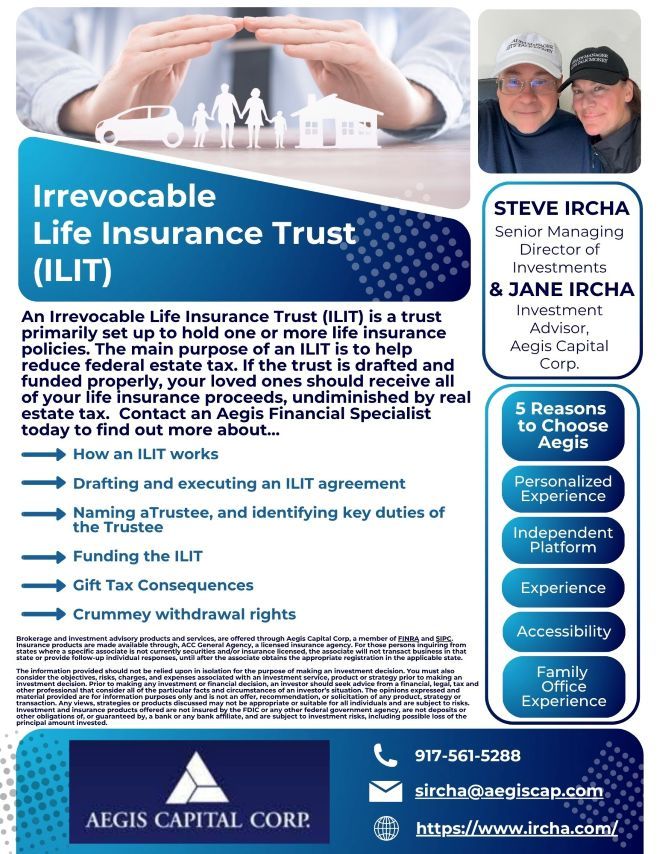
An ILIT is a trust primarily set up to hold one or more life insurance policies. The main purpose of an ILIT is to avoid federal estate tax. If the trust is drafted and funded properly, your loved ones should receive all of your life insurance proceeds, undiminished by estate tax.
How an ILIT Works
Because an ILIT is an irrevocable trust, it is considered a separate entity. If your life insurance policy is held by the ILIT, you don't own the policy — the trust does.
You name the ILIT as the beneficiary of your life insurance policy. (Your family will ultimately receive the proceeds because they will be the named beneficiaries of the ILIT.) This way, there is no danger that the proceeds will end up in your estate. This could happen, for example, if the named beneficiary of your policy was an individual who dies, and then you die before you have a chance to name another beneficiary. Because you don't own the policy and your estate will not be the beneficiary of the proceeds, your life insurance will escape estate taxation.
Caution: Because an ILIT must be irrevocable, once you sign the trust agreement, you can't change your mind; you can't end the trust or change its terms.
Creating an ILIT
Your first step is to draft and execute an ILIT agreement. Because precise drafting is essential, you should hire an experienced attorney. Although you'll have to pay the attorney's fee, the potential estate tax savings should more than outweigh this cost.
Naming the Trustee
The trustee is the person who is responsible for administering the trust. You should select the trustee carefully. Neither you nor your spouse should act as trustee, as this might result in the life insurance proceeds being drawn back into your estate. Select someone who can understand the purpose of the trust and who is willing and able to perform the trustee's duties. A professional trustee, such as a bank or trust company, may be a good choice.
Funding an ILIT
An ILIT can be funded in one of two ways:
1. Transfer an existing policy — You can transfer your existing policy to the trust, but be forewarned that under federal tax rules, you'll have to wait three years for the ILIT to be effective. This means that if you die within three years of the transfer, the proceeds will be subject to estate tax. Your age and health should be considered when deciding whether to take this risk.
2. Buy a new policy — To avoid the three-year rule explained above, you can have the trustee, on behalf of the trust, buy a new policy on your life. You can't make this purchase yourself; you must transfer money to the trust and let the trustee pay the initial premium. Then, as future annual premiums come due, you continue to make transfers to the trust, and the trustee continues to make the payments to the insurance company to keep the policy in force.
Gift Tax Consequences
Because an ILIT is irrevocable, any cash transfers you make to the trust are considered taxable gifts. However, if the trust is created and administered appropriately, transfers of $19,000 (in 2026 unchanged from 2025) or less per trust beneficiary will be free of federal gift tax under the annual gift tax exclusion.
Additionally, each of us has a gift and estate tax applicable exclusion amount, so transfers that do not fall under the annual gift tax exclusion will be free of gift tax to the extent of your available applicable exclusion. The gift and estate tax applicable exclusion amount is equal to the basic exclusion amount of $15,000,000 (in 2026; $13,990,000 in 2025) plus any applicable deceased spousal unused exclusion amount. Both the annual exclusion and the basic exclusion amount are indexed for inflation and may change in future years
IMPORTANT DISCLOSURES Broadridge Investor Communication Solutions, Inc. does not provide investment, tax, legal, or retirement advice or recommendations. The information presented here is not specific to any individual's personal circumstances. To the extent that this material concerns tax matters, it is not intended or written to be used, and cannot be used, by a taxpayer for the purpose of avoiding penalties that may be imposed by law. Each taxpayer should seek independent advice from a tax professional based on his or her individual circumstances. These materials are provided for general information and educational purposes based upon publicly available information from sources believed to be reliable — we cannot assure the accuracy or completeness of these materials. The information in these materials may change at any time and without notice.
Crummey withdrawal rights
Generally, a gift must be a present interest gift in order to qualify for the annual gift tax exclusion. Gifts made to an irrevocable trust, like an ILIT, are usually considered gifts of future interests and do not qualify for the exclusion unless they fall within an exception. One such exception is when the trust beneficiaries are given the right to demand, for a limited period of time, any amounts transferred to the trust. This is referred to as Crummey withdrawal rights or powers. To qualify your cash transfers to the ILIT for the annual gift tax exclusion, you must give the trust beneficiaries this right.
The trust beneficiaries must also be given actual written notice of their rights to withdraw whenever you transfer funds to the ILIT, and they must be given reasonable time to exercise their rights (30 to 60 days is typical). It's the duty of the trustee to provide notice to each beneficiary.
Of course, so as not to defeat the purpose of the trust, the trust beneficiaries should not actually exercise their Crummey withdrawal rights, but should let their rights lapse.
The key duties of an ILIT trustee include:
-Opening and maintaining a trust checking account
-Obtaining a taxpayer identification number for the trust entity, if necessary
-Applying for and purchasing life insurance policies
-Accepting funds from the grantor
-Sending Crummey withdrawal notices
-Paying premiums to the insurance company
-Making investment decisions
-Filing tax returns, if necessary
-Claiming insurance proceeds at your death
-Distributing trust assets according to the terms of the trust
The cost and availability of life insurance depend on factors such as age, health, and the type and amount of insurance purchased. Before implementing a life insurance strategy, it would be prudent to make sure that you are insurable. The use of trusts involves a complex web of tax rules and regulations and usually involves upfront costs and ongoing administrative fees. You should consider the counsel of an experienced estate conservation professional before implementing a trust strategy.
IMPORTANT DISCLOSURES Broadridge Investor Communication Solutions, Inc. does not provide investment, tax, legal, or retirement advice or recommendations. The information presented here is not specific to any individual's personal circumstances. To the extent that this material concerns tax matters, it is not intended or written to be used, and cannot be used, by a taxpayer for the purpose of avoiding penalties that may be imposed by law. Each taxpayer should seek independent advice from a tax professional based on his or her individual circumstances. These materials are provided for general information and educational purposes based upon publicly available information from sources believed to be reliable — we cannot assure the accuracy or completeness of these materials. The information in these materials may change at any time and without notice
Aegis Capital Corp.
Steve & Jane Ircha & Richard Palmadesso

Pictured: Steve & Jane Ircha
Steven Ircha Senior Managing Director 26 Paxton Ave. 914-361-1099 This email address is being protected from spambots. You need JavaScript enabled to view it. https://www.ircha.co


Financial & Legal Assistance Directory
Hymes & Associates, CPA, P.C.
Our firm provides outstanding service to our clients because of our dedication to the three underlying principles of professionalism, responsiveness, and quality.
Listed as one of the 10 largest firms by The Westchester Business Journal, we serve clients throughout the tri-state area. By combining our expertise, experience, and
the energy of our staff, each client receives close, personal and professional attention.
Our high standards, service, and specialized staff spell the difference between our outstanding performance and other firms. We make sure that every client
is served by the expertise of our whole firm.
Hymes & Associates, CPA, P.C.
55 Pondfield Road
Bronxville, NY 10708
914-961-1200
914-961-1715 (Fax)
Website: www.hymescpa.com
Baillie & Hershman
44 Pondfield Road, Suite - 12
Bronxville, N.Y. 10708
Office: 914-337-6300
Matthew W. Kerner, ESQ.
Direct Dial: 914-337-6569
Email: This email address is being protected from spambots. You need JavaScript enabled to view it.
Fax: 914-337-6913
Suzanne M. Bloomer, Esq.
Direct Dial: 914-337-0142
This email address is being protected from spambots. You need JavaScript enabled to view it.
Baillie & Hershman provides comprehensive Real Estate legal services for buyers, sellers, current owners, real estate agents and lenders. We also handle estate planning, including the drafting of wills.
Griffin, Coogan, Sulzer & Horgan, P.C.
Attorneys and Counselors at Law
Griffin, Googan, Sulzer & Horgan, R.C.
Located in Bronxville, New York, Griffin, Coogan, Sulzer & Horgan, P.C. takes great pride in providing our clients with comprehensive, high quality legal services in a responsive manner. The firm concentrates its practice in real estate law with a primary focus on issues relating to real estate tax litigation (also known as tax certiorari), real estate transactions, valuation law, real property taxation and tax planning and real property tax exemption matters throughout New York State.
The firm serves as general counsel for several local cooperatives and represents clients in various issues relating to wills, trusts and estate planning.
51 Pondfield Road
Bronxville, NY 10708
(914) 961-1300
This email address is being protected from spambots. You need JavaScript enabled to view it.
Nobile, Magarian & DiSalvo LLP
We are hardworking and dedicated attorneys who, combined, have more than 150 years of experience delivering quality legal advice. Our cutting edge is our ability to enter both the conference room and the courtroom with strength. Our law firm provides legal representation and counsel for both individual and business clients on issues related to estate planning and administration, real estate law, litigation, and business law. Our practice areas include: Commercial Litigation, Business Law, Real Estate, Wills, Estate Planning, Trusts, Estate Administration, Living Wills, Health Care Proxies, Powers of Attorney, Not For Profits, and Employment Law.
111 Kraft Avenue
Bronxville, NY 10708
914-337-6300
Veneruso, Curto, Schwartz & Curto, LLP
Veneruso, Curto, Schwartz & Curto is dedicated to providing businesses and individuals with exceptional legal services customized to each client's needs and objectives. Practice areas include litigation, real estate, not for profit, wills and estate planning, land use and zoning, business and corporate, cooperative and condominium and real estate tax assessment litigation.
The Hudson Valley Bank Building
35 East Grassy Sprain Road, Suite 400
Yonkers, New York 10710
914-779-1100
Aegis Capital
Steve brings 40 years of investing experience to his role as Senior Managing Director at Aegis Capital Corp., a prominent national securities firm.
Financial Legal Assistance Recent Articles








Quick Links
Newsletter
MyhometownBroxnville reserves the right to monitor and remove all comments. For more information on Posting Rules, please review our Rules and Terms of Use, both of which govern the use and access of this site. Thank you.
The information presented here is for informational purposes only. While every effort has been made to present accurate information, myhometownBronxville, LLC, does not in any way accept responsibility for the accuracy of or consequences from the use of this information herein. We urge all users to independently confirm any information provided herein and consult with an appropriate professional concerning any material issue of fact or law. The views and opinions expressed by the writers, event organizers and advertisers do not necessarily represent those of myhometownBronxville, LLC, its officers, staff or contributors. The use of this website is governed by the Terms of Use . No portion of this publication may be reproduced or redistributed, either in whole or part, without the express written consent of the publisher.
Copyright © 2009 myhometownbronxville.com, All rights reserved.